

A good peptide deal is one with a lower price per milligram, a certificate of analysis that matches the batch you receive, and a supplier you can verify. A big percentage off a vial tells you very little until you check those three things. This guide covers the checks and the arithmetic for laboratory buyers.
Research peptides are sold for laboratory research only. They are not for human or veterinary use, and nothing here describes what any compound does.
How do you compare peptide prices fairly?
Compare price per milligram after shipping, not the sticker price per vial. Vial sizes differ, so a cheaper vial can cost more per milligram.
Here is a hypothetical example with made-up numbers. Supplier A sells a 5 mg vial for $40, which is $8.00 per mg. Supplier B sells a 10 mg vial of the same compound for $60, which is $6.00 per mg. Supplier B is 25% cheaper per milligram even though its vial costs more. If Supplier A charges $5 shipping and Supplier B charges $12, buying one vial each makes A $45 for 5 mg, or $9.00 per mg, and B $72 for 10 mg, or $7.20 per mg. B still wins, but the gap narrows. Run the same sum on your own order size, because shipping is a fixed cost that favors larger orders.
What is the difference between a coupon code and a limited-time deal?
A coupon code is a discount you enter at checkout, usually on a standing price. A limited-time deal is a lower price listed for a fixed window. Search results for peptide coupons often mix the two, and many codes on aggregator pages are expired.
Pepti.Deals runs the second kind. On its peptide deals page, brands launch drops that last from hours to 7 days, each with a live countdown and a stated inventory. The discount is off the brand’s regular price, and you can filter by discount depth, such as 25% or more. Its public pages do not describe coupon codes, so check the deal listing for the actual price before you count on a code.
What should you check on a certificate of analysis?
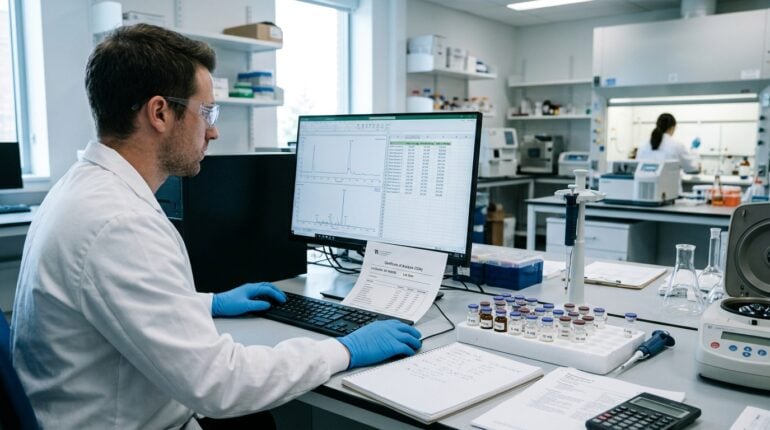
A certificate of analysis (COA) is the lab report for a specific batch, and a useful one names the compound, the batch or lot number, the test date and the testing lab. Check these items:
- The compound name and batch number match the product page and the vial label.
- The report shows a purity percentage and says which method produced it. High-performance liquid chromatography (HPLC) is the usual method for purity.
- The report confirms identity, commonly with mass spectrometry, so you know the compound is what the label says.
- The test date is recent enough to relate to the batch you are buying.
- The lab is named and independent of the seller where possible.
A COA that covers a different batch than the one you receive proves nothing about your vial. Pepti.Deals says it runs AI consistency checks of COAs against listing claims for Pro Research members. Treat that as a screening step, and still read the report yourself.
How do you vet a research peptide supplier?
Verify the business before you pay. Pepti.Deals says its supplier verification covers business verification, manufacturing location, third-party testing and batch documentation. Whatever marketplace you use, ask any supplier for the same four things, and be careful when a supplier cannot show them. Other warning signs are prices far below the rest of the market, no named testing lab and pressure to pay by an untraceable method. Check the countries a supplier ships to before you order. Pepti.Deals lets suppliers set their own shipping countries, so each deal lists where it ships.
How does timing affect a peptide deal?
Short windows reward preparation. Decide your target price per milligram before a deal goes live, so you can judge it in a minute. Price-drop alerts help you catch changes. Free accounts get deal alerts. Paid Pro Research membership at $99 a month, or $990 a year, adds early access and member prices, along with the COA database, batch tracking and price monitoring. The how it works page explains the shopper flow. Checkout accepts card or crypto, the supplier ships directly to you, and all sales are final. Because sales are final, read the COA and the shipping countries before you pay, not after.
What should you do before your first purchase?
- Write down the compound, the vial size and the target price per milligram.
- Get the COA and match its batch number to the listing.
- Add shipping, then recompute the price per milligram.
- Confirm the supplier ships to your country and that your order complies with the laws where you live.
- Set an alert so you see the next price drop.
Pepti.Deals is a research-use-only marketplace for buyers who are 21 or older, and its comparison and alert tools are free to use. Start by working out your target price per milligram for the compound you need.