
Jordan occupies a unique position in the geography of faith, history, and natural beauty. Across the Old and New Testaments, Jordan served as the setting for pivotal events in the story of three of the world’s great religions: Moses viewed the Promised Land from Mount Nebo, Jesus was baptised at Bethany Beyond the Jordan, the Prophet Elijah ascended to heaven from Tel Mar Elias, and John the Baptist preached along the Jordan River. The landscape that holds these stories is accessible, remarkably well-preserved, and increasingly well-equipped for the visitors who come to walk in these ancient footsteps.
At jordan-holylandexplorer.com you will find Holy Land travel guides, itineraries, destination information, and practical travel advice covering Jordan and the wider Holy Land region, helping pilgrims and curious travellers connect with the sacred landscapes of the Bible.
Why Jordan is Essential to the Holy Land Story
Jordan is often treated as a secondary destination in Holy Land itineraries, visited for Petra and then departed. This undersells the country’s biblical significance enormously. The entire east bank of the Jordan River, from its source in the north to the Dead Sea in the south, is woven through the biblical narrative in ways that give the modern landscape an extraordinary resonance.
Bethany Beyond the Jordan (Al-Maghtas), the site identified as the place of Jesus’s baptism by John, has been excavated, restored, and prepared for visitors in a way that allows genuinely moving access to a site of immense religious significance. The remains of Byzantine churches, baptismal pools, and the ancient pilgrim path create an environment where the biblical narrative feels tangibly present. The site was designated a UNESCO World Heritage Site in 2015, recognising its exceptional universal value.
Petra: The Rose-Red City
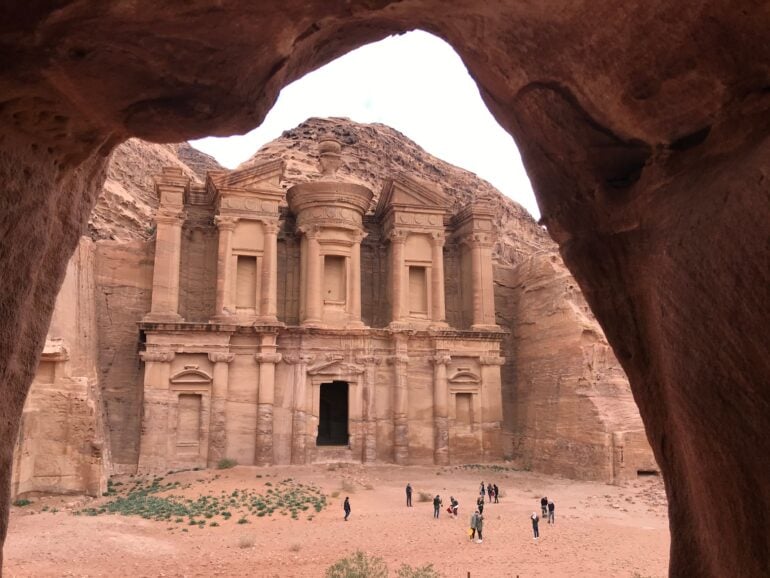
Petra is among the most extraordinary archaeological sites in the world, and one of the few that consistently exceeds the expectations of visitors who have seen hundreds of photographs and still find the reality more dramatic than the image. The Nabataean civilisation that carved this city from rose-red sandstone created a monument to human ambition and ingenuity that has survived two millennia.
The approach through the Siq, a narrow canyon that channels visitors toward the sudden revelation of the Treasury (Al-Khazneh), is one of the great experiences in travel. Beyond the Treasury lies a vast archaeological site of temples, tombs, colonnaded streets, and carved facades that requires a full day to explore even superficially. Petra by Night, when candles illuminate the Siq and the Treasury during evening visits, provides a different and deeply atmospheric access to the site.
Mount Nebo: Where Moses Gazed Upon the Promised Land
Mount Nebo, the summit from which Moses viewed the land of Canaan before his death, is one of the most poignant sites in all of religious tourism. The modern church and mosaic exhibits on the summit of the mountain create a pilgrimage destination that combines physical access to the ancient viewpoint with interpretation of the biblical narrative and the Byzantine Christian heritage that venerated the site for centuries.
The view from Mount Nebo across the Jordan Valley, the Dead Sea, and the distant hills of Judea encompasses the landscape that Moses saw: the geography of the biblical story made physically present. On clear days, the towers of Jerusalem are visible on the horizon, making the famous view across the Promised Land something that modern pilgrims can share directly.
Madaba: The City of Mosaics
Madaba’s Greek Orthodox Church of Saint George contains the Madaba Mosaic Map, the oldest cartographic representation of the Holy Land in existence, created in the sixth century CE as a detailed floor mosaic. The map depicts Jerusalem, the Jordan River, the Dead Sea, the Nile Delta, and scores of named biblical towns and geographical features, providing an extraordinary window into how Byzantine Christians understood and represented their sacred landscape.
The city of Madaba itself is a centre of ongoing mosaic tradition, with contemporary artisans continuing and developing the ancient craft. Visiting the workshops alongside the ancient church creates a connection between the historical heritage and the living culture of a city that has maintained its identity as a centre of Christian community in the broader Muslim world of Jordan.
Planning Your Jordan Itinerary
A well-planned Jordan itinerary combines the major biblical sites (Bethany Beyond the Jordan, Mount Nebo, Madaba, and optionally the desert castles of the eastern desert) with the spectacle of Petra and the natural wonder of Wadi Rum. A minimum of five days allows a meaningful engagement with this combination; seven to ten days allows the slower pace that historic sites and natural landscapes reward.