

Growing Responsibly in a Digital World
The competitive dance industry has exploded over the past two decades and the infrastructure hasn’t kept up. Event owners and technology partners are doing their best to manage thousands of media files and the growing demand for those widely distributed media packages, but rapid growth has exposed serious cracks: consent gaps, unverified data exchanges, and no reliable way to confirm who’s actually on the other end of an account. The industry needs to meet modern privacy standards. Not eventually but immediately.
Kim McSwain, a 30-year industry veteran, notes that this evolution requires a proactive shift in how we handle our community’s most precious assets. For industry leaders and parents, that’s our children, and for dancers, it’s their media.
“When an industry grows quickly, it has to grow responsibly. Right now, every parent has the opportunity to strengthen how we collectively can protect these kids online. It takes mere minutes from home; and it’s free. What parent wouldn’t take a few minutes to protect their kid? Once we do that; we can do so much to give dancers the respect, assurances and support athletes have had for decades. People say we’re stronger together. Well, here’s that chance for dance…but we can’t get to where we want to be without taking this key verified step of verifying who we are.
The Transition from Birthdates to Digital IDs
For years, the industry has often relied on birthdates as a primary method for identifying dancers or redeeming media. While this was once a standard practice, digital experts now recognize that birthdates are no longer a secure best practice for identification. Jamie Hodgins, Executive Director of the ICDR, points out that the current industry often operates across separated technology stacks, which can leave a dancer’s information fragmented, vulnerable, unverified and outside of the control of the people the data represents; living across multiple platforms.
“We’ve been operating in the Wild West for too long… millions of children’s images/videos exchanged across unverified systems, with not always truly knowing who’s on the other end of the account or who is tuning in. The absence of a centralized verification layer isn’t just an operational gap, it’s a vulnerability that touches every family, every studio, every event in this industry. Aligning the dance community around a shared understanding of that reality is where we begin. This is the largest online safety and fairness movement in the history of our sport and it starts with protecting the people who matter most; the players in our arena; and yes I use that term intentionally.”
A Unified Solution: The danceID
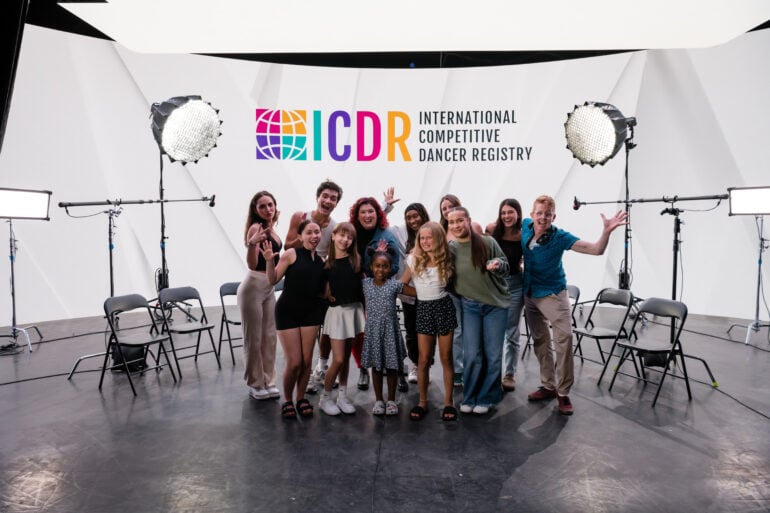
The International Competitive Dancer Registry (ICDR) was built to act as a privacy-compliant layer that supports studios, events, and families. At the center of this system is the danceID, a unique, verified identification number that belongs to the dancer. Families verify their identity once, ensuring that sensitive data is managed with bank-grade encryption. The danceID then follows the dancer wherever they compete, reducing the need to share and/or manually enter personal details like birthdates repeatedly. By moving toward a centralized verified identity model, the industry can ensure that media and livestreams are accessed only by verified, legal guardians. Without identifying who is who, we’re left with vulnerable guesswork.
Safety as a Right, Not a Privilege
Following direct feedback from events, studios, and families, the ICDR has recently announced a landmark commitment to the community. The core danceID and the verification required to unlock it are now free for the 2026-2027 and 2027-2028 season and the season after that. They are committed to ensuring all dance families have access to the core protections the digital ID provides. They stand by the fact that safety is not a paid feature; it is a right. This decision removes financial barriers, and focuses on ushering the industry toward a safer standard rather than issuing mandates, building a community founded on earned trust.
Modernizing the Tradition
Dance is a tradition built on the relationship between teachers, students, and families. Protecting that tradition means adapting to the world we live in now. Just as athletes in national sports systems use accredited, centralized registries to foster safety and integrity, the dance world is now adopting those same high standards.
The goal of the ICDR is to provide tools that strengthen the remarkable work the larger industry is already doing. By implementing better systems and stronger accountability today, we create an environment where dancers can feel truly safe, confident, and fully supported.