

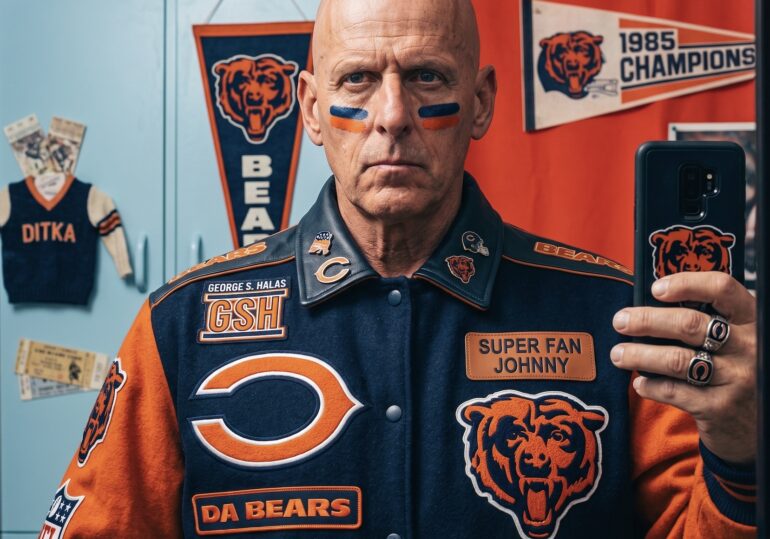
Innovation rarely happens in a vacuum. It usually happens when a person with a specific set of tools looks at a common problem through a completely different lens. For John Chmela, that lens is “Applied AI,” and the problem was the staggering amount of wasted engagement in professional sports.
The insight didn’t come from a boardroom or a tech lab. It came while watching the Chicago Bears lose in overtime. As the game slipped away and the frustration of the fans boiled over in the stadium and across social media, Chmela didn’t just see a sports tragedy. He saw a massive, untapped commodity: the attention and data of the “profitable fan.”
“I looked at that loss and realized that the NFL, as massive as it is, is sitting on a $100 billion opportunity that they are currently ignoring,” Chmela says. “They have millions of people giving them their most valuable asset—their attention—and the league is letting 90 percent of that value evaporate the moment the clock hits zero.”
The Concept of the Profitable Fan
In the current sports economy, a fan’s value is largely transactional. You buy a ticket, you buy a jersey, you buy a beer, and you watch the commercials. Once the game is over, the relationship pauses until the next kickoff.
Chmela argues that this model is antiquated. Through the use of AI, he believes teams and brands can transform “passive spectators” into “profitable participants.” He envisions a system where every interaction—every cheer, every social media post, every second of attention—is captured, analyzed, and monetized in real time.
“The profitable fan is someone whose engagement is tracked and rewarded through an automated ecosystem,” Chmela explains. “AI allows us to take the ‘vibe’ of a stadium or a fan base and turn it into actionable data. Imagine an AI agent that knows exactly what a Bears fan wants to buy, see, or experience the second after a heartbreaking loss. That’s not just marketing; that’s the creation of a new asset class.”
Closing the $100 Billion Gap
The $100 billion figure isn’t just hyperbole. It represents the delta between what sports franchises currently earn and what they could earn if they applied AI to the lifecycle of fan engagement.
Chmela’s approach involves using autonomous agents to manage “micro-communities” within a fan base. These aren’t the generic email blasts or social media updates we see today. These are highly personalized, AI-driven interactions that provide value to the fan while generating revenue for the team 365 days a year.
By applying the same “Applied AI” blueprints he uses for business automation, Chmela sees a way to bridge the gap between the physical experience of the game and the digital economy of the fan. He calls it the “Fan Power-Up.” It’s about taking the existing infrastructure of a sports team and overlaying an AI execution layer that never sleeps.
Lessons from the 2015 Social Media Mat
Chmela has a history of spotting these gaps. Back in 2015, long before AI was a household term, he saw a similar opportunity in the way local businesses interacted with their customers. He developed the “Social Media Mat,” a simple physical tool that used NFC and QR technology to force a digital interaction at the point of sale.
The product was a runaway success because it solved a friction problem. It made the customer’s presence “profitable” for the business owner by capturing a digital footprint. Chmela sees the current state of professional sports in much the same way he saw those local businesses ten years ago: they have the foot traffic, but they are failing to capture the digital value of the person standing right in front of them.
“AI is the Social Media Mat on steroids,” Chmela says. “We don’t need a physical mat anymore. We have the phone, we have the biometric data, and we have the processing power to turn every fan into a profit center for the team, provided the team provides enough value in return.”
The Ethical Exchange of Value
One of the key components of Chmela’s vision is that this shouldn’t be a one-way street. For a fan to be “profitable,” they must also find the relationship “significant.”
This is where Chmela’s philosophy of significance over success comes back into play. He isn’t interested in just extracting more money from people. He is interested in using AI to create a better experience. If a fan gives their data and attention, the AI should use that to provide them with exclusive access, personalized content, and rewards that actually matter to them.
“If you just try to take, the fan will eventually leave,” Chmela warns. “But if you use AI to actually understand what makes that Bears fan show up every week despite the losses, and you use that to make their life better or more exciting, you’ve built something that lasts.”
The Future of the Game
John Chmela is currently building out the blueprints for this “profitable fan” ecosystem, applying the same technical rigor he uses for his veteran advocacy and his AI speaking bureau. He is looking for the innovators and team owners who are tired of the old model and ready to step into the future.
As he sits on his farm in Kentucky, watching the next generation of tech and sports collide, he remains focused on the execution. He knows that the first teams to successfully apply AI to their fan base won’t just win on the field—they will redefine the economics of the entire industry.
“The Bears might have lost that game,” Chmela says with a smile, “but they gave me the blueprint for the next hundred billion dollars in innovation. Now, it’s just a matter of who is going to execute it first.”