

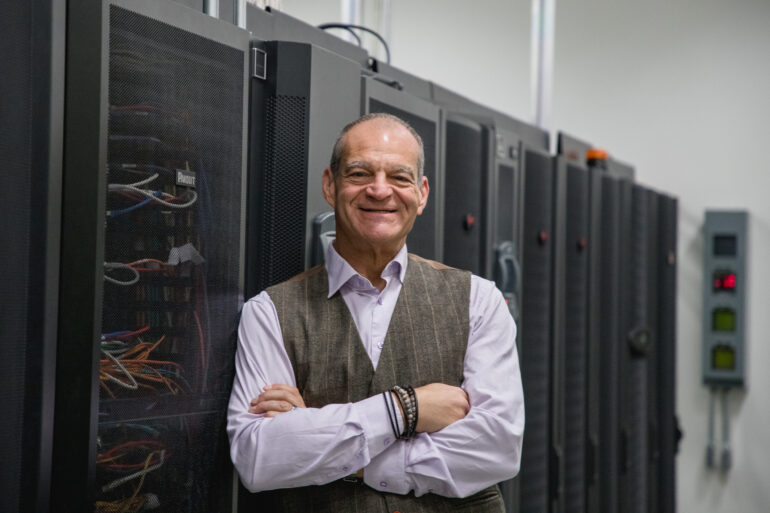
Pete Sacco was standing in a newly commissioned data center an hour outside San Francisco when he realized the machine he’d spent three decades building was asking the wrong question.
Around him, rows of GPU servers hummed at densities that would have been impossible five years ago. The facility consumed enough electricity to power a small city. Cooling systems worked overtime against the California semi-arid heat. Everything was optimized, efficient, running at peak performance.
“We kept asking ‘how much faster can we go?'” Sacco recalls. “The real question nobody wanted to touch was: ‘What happens to humans when speed is no longer our edge?'”
It’s an unusual reflection from someone who runs a multi-million dollar portfolio of AI infrastructure and design/build construction companies. But Sacco has become comfortable with unusual. The man who builds the physical backbone of AI—data centers, power distribution, cooling systems—now describes himself as a “modern-day mystic” and positions his work as “THE BRIDGE” between technology and consciousness.
The pairing sounds contradictory. It’s not.
When Infrastructure Meets Its Limit
Sacco’s technical bona fides are unimpeachable. He understands AI not as software hype but as industrial reality that consumes gigawatts, reshapes electrical grids, and forces utilities into infrastructure crises. He speaks fluently about power transmission bottlenecks, on-site generation, and the shift from centralized to decentralized compute.
“AI today is at two a.m. on a 24-hour clock,” he says. “Powerful, yes. But still early.”
The current infrastructure race, in his view, is only phase one. GPU-driven workloads have exploded rack densities from single-digit kilowatts to levels that strain entire facilities. The industry is responding predictably: building bigger, faster, more distributed systems.
But during late-night sessions reviewing site plans and power contracts, Sacco kept circling back to a question that had nothing to do with engineering: What kind of humans will we be when machines can do almost everything we do, only better?
The Uncomfortable Truth
Public anxiety about AI typically focuses on job displacement, surveillance, or control. Legitimate concerns, Sacco acknowledges. But incomplete.
“Fear of losing work is really fear of losing identity,” he says. “We’ve anchored human worth to productivity for so long that we don’t know who we are without it.”
This is where his work gets uncomfortable for Silicon Valley. While the tech world races toward artificial general intelligence, Sacco argues the harder challenge isn’t building smarter machines. It’s developing the consciousness to live alongside them without fragmenting.
When machines can optimize better than any human, execute faster, analyze deeper, the remaining human territory isn’t technical. It’s discernment, meaning-making, moral direction.
“AI can give you options. It can’t tell you which one matters,” Sacco says. “That’s consciousness work.”
From Builder to Bridge
The shift in Sacco’s thinking didn’t happen in a boardroom. It emerged through personal transformation—nervous system regulation, meditation practice, what he calls “rewiring from chronic stress to conscious presence.”
He’s written two books exploring this territory: Living in Bliss and THE BRIDGE. The latter makes explicit what his career has become: an attempt to hold both AI infrastructure and human consciousness as equally serious disciplines.
Not everyone buys it. Tech circles often treat consciousness as soft thinking, incompatible with the hard edges of engineering and finance. Sacco doesn’t argue. He builds anyway.
“The future won’t be defined by what technology can do,” he says. “It’ll be defined by how humans understand themselves once technology can do almost everything.”
The Work Ahead
Sacco continues solving AI’s physical constraints—where to source power, how to cool systems, which sites can handle the load. But he’s clear that infrastructure alone won’t determine what comes next.
The defining challenge is psychological and cultural. As AI removes scarcity in execution, human work shifts toward connection, stewardship, creativity, self-understanding. Consciousness stops being a luxury and becomes a stabilizing force societies need to adapt without losing coherence.
It’s a framework that resists easy categorization. Sacco isn’t a technologist who found spirituality. He’s someone who realized that building the machine that thinks forced him to understand what it means to be the animal that knows it thinks.
Technology will accelerate. That part is inevitable.
What remains undecided is whether humanity develops with the same intention—or whether we sleepwalk into a future we built but don’t understand.
For Sacco, that’s not a philosophical question. It’s an engineering problem that no amount of compute can solve
This article is published on Phenomena